Hear from Mary Jane Nirdlinger, Deputy Town Manager of Chapel Hill, NC about their recent lanch of their Plain Language Center of Excellence and adoption of generative AI.
The Town of Chapel Hill, North Carolina, needed to evolve their communications strategies to meet the demands of their town’s growth. Chapel Hill already had a lot of work done in this area, ranging from a plain language initiative to training, but they wanted to take this a step further – building on their existing efforts to scale plain language across the organization and leverage the power of Generative AI.
Challenge
The Town of Chapel Hill needed a partner to help bring together their existing projects and create a strategic plan for the future. This was no small task as they had over 700 employees, many with differing skills and needs, that needed to be considered. They had to also consider their policy needs, and develop a way to integrate Generative AI into their workflow.
“Growing an effort like this while also doing our day-to-day work has been a challenge, but we had a lot of groundwork from previous, smaller trainings.” Mary Jane Nirdlinger, Deputy Town Manager of Chapel Hill, NC
Solution
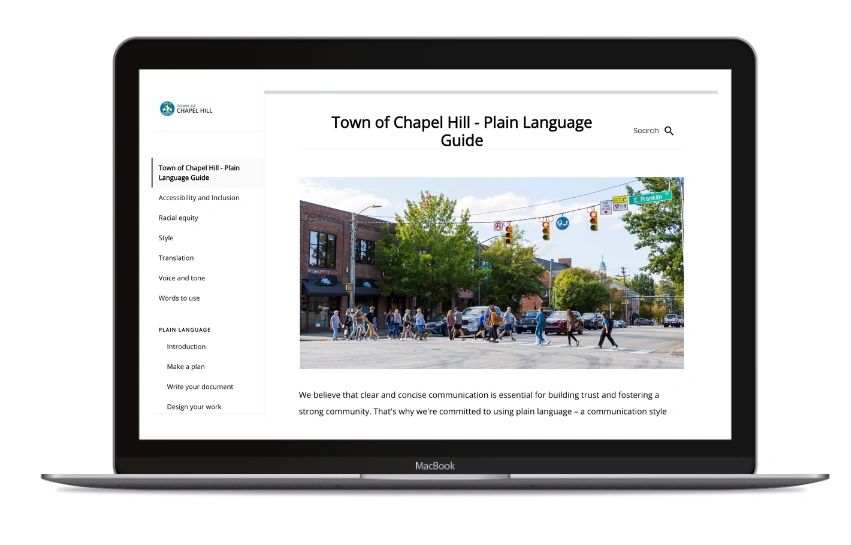
To help bring these efforts together, the Town of Chapel Hill hired us to help strategize and execute their plan. We worked with the Town of Chapel Hill to develop a comprehensive training program, a style guide, and generative AI best practices. This included developing curriculum and materials for the training program and experimenting with AI-based generative tools to see how they could fit into the Town’s communications efforts.
How has the recent launch of this initiative positively impacted communication with your employees, town residents, and community members?
Our employees use Plain Language skills for everything from internal emails to Town Council memos and community communications. The adoption of a Plain Language mindset takes time, but we are seeing that most people quickly appreciate the value of improving their communications and are grateful to have tools and guidance they can use.
More importantly, this effort has raised awareness around the why of plain language: transparency, trust, and inclusion. We launched our online style guide, training, and generative AI tools together and are spreading them throughout our organization.
What challenges, if any, did you face during the launch, and how were they overcome?
Growing an effort like this while also doing our day-to-day work has been a challenge, but we had a lot of groundwork from previous, smaller trainings.
Working with Content Matters gave our team the boost we needed to spend some focused time and energy on bringing our one-off efforts together and taking them to the next level. It was helpful to have someone pull our “homegrown” materials together into cohesive training content, to help us strategize and track the development and roll-out of the center, and to help develop the style-guide and pilot projects to demonstrate the value of the efforts.
We also benefited from outside guidance and expertise on tools, specifically generative AI, and how they could integrate with our plain language program.
Rolling out a new effort in an organization of 700+ employees with different areas of expertise and work responsibilities is a challenge. We started with the organization-wide tools (style guide, training) and are customizing the in-person training workshops and communications to match the individual departments’ needs.
For the Generative AI element, we had to consider our organization’s interests, develop a policy, and put that in place before rolling out our pilot. We are starting with a 50-person test-group so we can understand how best to integrate generative AI at a wider level.
What impact do you expect plain language principles and generative AI technology will have on the overall perception of Chapel Hill among your different audiences?
We hope our audiences will see clearer, more useful information that they can use. We have gotten some early positive feedback from our Town Council about the improvements to their regular agenda items.
Our pilot team using generative AI has just launched and they are already using the tool on a regular basis. We will be tracking and measuring our progress over the next several months.
What advice would you give to other organizations?
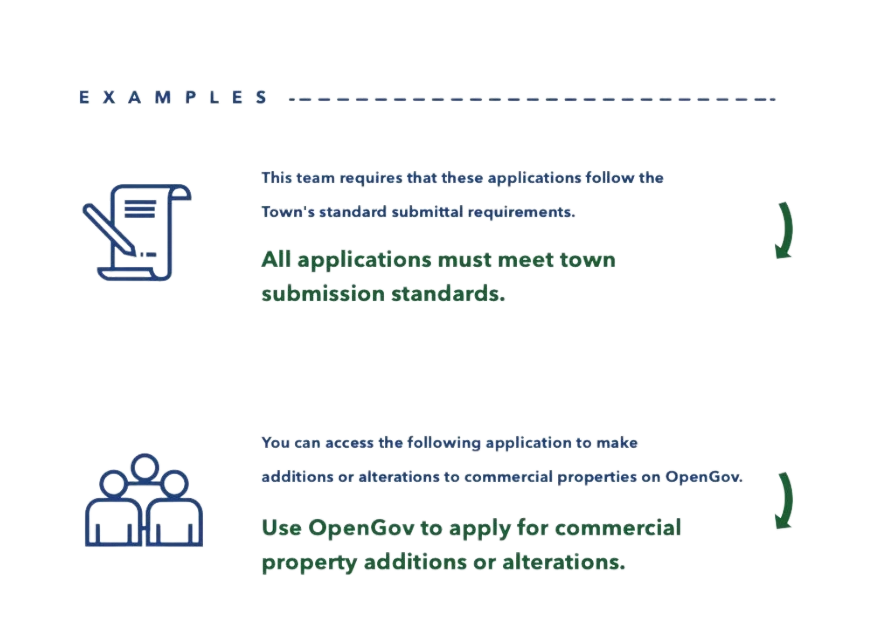
It’s useful to have a vision for what you’re trying to accomplish. That helps you make decisions about tools, training, and metrics. It’s also useful to have organizational support and direction. We created a Plain Language policy to articulate that this was a priority for our organization.
Communicate regularly. Frequent updates to our leadership and our content producers helped spread understanding of the initiative and support use of the various tools (style guide, training, generative AI).
Don’t be afraid to try new things. We are testing and piloting, which gives us time to experiment and understand new efforts. It also allows us to change our approach if something isn’t working for us. We’re not waiting for someone else to ‘figure it all out’ before we make changes.
People are using generative AI. We wanted to provide an “approved” tool for our staff to experiment with and test, before they all begin adopting tools on their own.
How do you envision the future of content creation and communication for Chapel Hill?
By getting our Center of Excellence and generative AI tools in line, we’ll be in a better place to improve our content production, support our communicators in producing excellent content, doing all of this in a clear way and transparent to our community, and operating in a way that meets our cyber-security interests.
We foresee our staff spending more of their time on creative, professional work, and less time on repetitive or basic communications without decreasing the quality of our work. In fact, our goal is to improve the quality of our communications and our content.